

Dojo Caracal
Budo Taijutsu
Budo Taijutsu is a Japanese martial art developed by Masaaki Hatsumi on the basis of nine traditional schools of martial arts that make up the Bujinkan organization. Three of them are ninjutsu schools, and six are schools of bujutsu, the martial arts of the samurai.
Training combines movement against an opponent, strikes, kicks, throws, joint locks, chokes, falls and rolls, alongside weapons work. It deals with distance, timing, position, self-control, control of the opponent, and the ability to cope with unexpected situations.
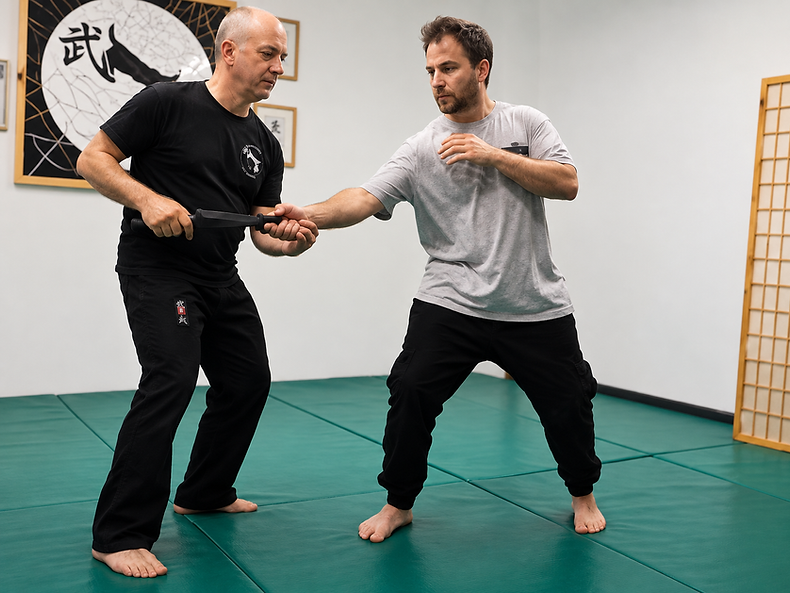
Partner work in Budo Taijutsu, practicing movement, timing, position and control
Nine Martial Traditions
The nine traditions of the Bujinkan fall into two groups. Three of them, Togakure-ryū, Gyokushin-ryū and Kumogakure-ryū, are ninjutsu traditions that carry the term ninpō in their names. The other six are bujutsu traditions. Each of the nine traditions emphasizes its own aspects, techniques and combat principles.
Taijutsu (体術) means “the art of the body.” It includes the ways of moving and fighting with the body, among them maneuvering, managing distance, posture, strikes, kicks, grips, throws and control. The Japanese term ryū (流) describes a tradition or stream of knowledge passed down from generation to generation, not just a collection of techniques.
In Bujinkan training, the nine traditions are studied within one overall framework, and not only as separate systems side by side. Each tradition has its own emphases, but studying them makes it possible to examine through them shared principles of movement, distance, timing, body structure and control.
At the end of 2019, around his 88th birthday, Hatsumi began passing the title of sōke (head of the tradition) of each tradition to one of his senior students. The appointments apply to each tradition separately and do not make any of the new sōke the head of the Bujinkan. The names of the founders and the founding dates below are based on Bujinkan tradition and on the sources listed at the bottom of the page. Some of them are the subject of scholarly debate, which I write about on the Tradition page.
Togakure-ryū Ninpō
戸隠流忍法
Ninpō (忍法) is a broader concept than fighting techniques alone. It concerns the ability to survive, adapt and act wisely when conditions change. In Togakure-ryū, combat is part of a wider system that includes taijutsu, weapons work, changing distance, evasion, concealment and use of the environment. Within the Bujinkan, this is one of the main traditions through which we study the connection between the martial art and ninpō: not only how to fight, but how to change, adapt and act within a reality that is not under our control.
Founder: Togakure Daisuke, in the Ōhō era (1161–1163).
Current sōke: Tsutsui Takumi, 35th sōke, appointed at the end of 2019
Gyokushin-ryū Ninpō
玉心流忍法
Gyokushin-ryū is one of the three ninpō traditions in the Bujinkan. Unlike traditions such as Gyokko-ryū and Kotō-ryū, very little of its technical material has been published, so it is hard to describe with confidence what it looks like in practice. The founder came from a Gyokko-ryū background, so the body movement of the school is close to that of Gyokko-ryū. For generations the school was taught in secret. In the 17th century it passed to the Toda family, when Toda Seiryū Nobutsuna, who was also sōke of Togakure-ryū, became its 11th sōke. Gyokushin-ryū is described as a tradition focused mainly on espionage, intelligence gathering, disguise and evasion, more than on face-to-face combat. It is particularly associated with the nagenawa, a throwing rope used to catch and bring down an opponent.
Founder: Sasaki Goemon Teruyoshi, in the Tenbun era (1532).
Current sōke: Kan Jun'ichi, 22nd sōke, appointed at the end of 2019.
Kumogakure-ryū Ninpō
雲隠流忍法
For Kumogakure-ryū, too, relatively little detailed technical material is publicly available. Within the Bujinkan it is associated with movement that allows rapid changes of distance and position, with unpredictable action, and with the use of weapons and unusual tools. The material taught in the Bujinkan includes, among other things, jumps, double actions and the kamayari, a spear with a side blade or hook. Because so little material is public, these details are best seen as a glimpse of the tradition rather than a definition of all of it.
Founder: Iga Heinaizaemon Ienaga, in the Tenbun era (1532–1554).
Current sōke: Furuta Kōji, 15th sōke, appointed at the end of 2019.
Gyokko-ryū Kosshijutsu
玉虎流骨指術
Kosshijutsu is a kind of taijutsu that uses body structure, angle, distance and precise striking to affect the opponent's structure and movement. It is not only about striking sensitive points. The essence is to create a situation in which position, timing and body structure work together, making it possible to achieve a great effect without relying mainly on muscular strength. In 2001 Hatsumi taught kosshijutsu through Gyokko-ryū, as part of a cycle of several years in which he taught, through different traditions, different ways of using the body.
Founder: Tozawa Hakuunsai, in the Hōgen era (1156–1159).
Sōke: Ishizuka Tetsuji, 29th sōke, appointed at the end of 2019; he died in March 2025. As of October 2026, I am not aware of a successor having been appointed.
Kotō-ryū Koppōjutsu
虎倒流骨法術
Koppōjutsu is a way of fighting that uses body structure, angle and timing to unbalance the opponent's posture and structure. The term is sometimes simplistically translated as “bone breaking,” but such a description greatly narrows its meaning. In Kotō-ryū the movement sometimes looks more direct and sharper than in Gyokko-ryū. Here too, the essence is not the use of brute force but the ability to reach the opponent's structure on the right line, at the right angle and at the right moment, while keeping an efficient body structure. Hatsumi used Kotō-ryū in 2000 to teach koppōjutsu, as part of the same teaching cycle.
Founder: Toda Sakyō Ishinsai, in the Tenbun era (1532–1555). According to the Bugei Ryūha Daijiten, Ishinsai received the teachings of Gyokko-ryū from Sakagami Tarō Kunishige, founded Kotō-ryū and passed it on to Momochi Sandayū.
Current sōke: Noguchi Yukio, 19th sōke, appointed at the end of 2019.
Shinden Fudō-ryū Dakentaijutsu
神伝不動流打拳体術
Dakentaijutsu is taijutsu in which strikes, kicks and movement are integrated into the action of the whole body. In Shinden Fudō-ryū the importance of natural movement stands out, movement that does not rely on a rigid stance or on purely local force. In 1998 Hatsumi also used this tradition to work on taihenjutsu: the ability to change the body's state, direction and position while moving, and to adapt to what is happening. The name of the tradition or its technical classification does not exhaust what can be learned through it.
Founder: Izumo Kanja Yoshiteru, in the Eikyū era (1113).
Current sōke: Nagato Toshirō, 27th sōke, appointed at the end of 2019.
Takagi Yōshin-ryū Jūtaijutsu
高木揚心流柔体術
Jūtaijutsu is a style of close-range combat in which the opponent's body is controlled through grips, joint locks, throws, chokes and changes to his structure. The goal is not to win by using force, but to learn how to enter the opponent's structure, change it and control it through position, timing and leverage. Takagi Yōshin-ryū is not limited to empty-hand work. The tradition also includes contexts of working against weapons and of control in situations where a sword is involved in the encounter. Hatsumi used this tradition in 2002 to teach jūtaijutsu.
Founder: Takagi Oriemon Shigenobu (1625–1711), in the 17th century.
Current sōke: Sakasai Norio, 18th sōke, appointed around 2020.
Gikan-ryū Koppōjutsu
義鑑流骨法術
Within the Bujinkan, Gikan-ryū is defined as a koppōjutsu tradition: working through body structure, angle and timing to affect the opponent’s structure, while striking bones, joints and weak points. It is known for its distinctive kicks, strikes and throws, and for deep, unusual stances that require good balance. The roots of its movement derive from Gyokko-ryū.
The school’s central motto is “Bufū ni sente nashi” (武風に先手なし): the first strike does not come from our side. In other words, it advocates refraining from initiating an attack and emphasizes harmony, timing and response.
Gikan-ryū is one of the six bujutsu traditions in the Bujinkan and is considered one of the rarest and least known among them. Hatsumi Sōke hardly ever taught it publicly. It has no official written kata in structured steps: it is passed on orally, with an emphasis on mastery of kūkan, the dynamic space.
The school’s founder, Uryū Hangan Gikanbō, was a daimyō (castle lord) in Kawachi Province. The name Gikan (義鑑) is interpreted as “the school of justice/truth” or “the mirror of justice.” Takamatsu Sōke first passed it on to his student Akimoto Fumio. Akimoto died of illness in 1962 without an heir, and the tradition passed to Hatsumi, its 15th sōke.
Founder: Uryū Hangan Gikanbō, in the Eiroku era (1558–1570).
Current sōke: Sakasai Norio, 16th sōke, appointed around 2020.
Kukishinden-ryū Happō Bikenjutsu
九鬼神伝流八法秘剣術
Happō bikenjutsu refers to a broad combat system in which taijutsu and weapons work are bound together. Kukishinden-ryū is one of the most important traditions in the Bujinkan for the study of weapons, among them the bō, a long staff; the yari, a spear; the naginata, a blade mounted on a pole; the jō, a shorter staff; and the sword. The importance of the tradition is not only in the variety of weapons. It makes it possible to learn how the same principles of body, distance, timing, angle and line keep working when the tool changes. The body is the foundation, and every tool the fighter picks up, a stick, a sword or a spear, becomes a direct extension of the body's movement.
Founder: Izumo Kanja Yoshiteru, in the Eiji era (1141).
Current sōke: Iwata Yoshio, 29th sōke, appointed around 2020

Partner work with weapons as part of Budo Taijutsu training.
Sources
The nine traditions: founders, dates and sōke: Bujinkan Toryu
Founder of Kotō-ryū, a translation of the entry in the Japanese encyclopedia Bugei Ryūha Daijiten: MartialTalk
Founder of Kukishinden-ryū and founding date: Genbukan
Bujinkan history and dates of the appointments: Bujinkan Huovi Dojo
The new sōke: Bujinkan Fudō-Myōō Dōjō
Gyokushin-ryū: Kogakure
Gikan-ryū: Kogakure
The Gikan-ryū lineage according to the Bugei Ryūha Daijiten: Samurai Archives
Takagi Yōshin-ryū: Kogakure
Kumogakure-ryū: Kihon.com
Hatsumi's yearly themes (1998–2002): Kumablog
Death of Ishizuka Tetsuji: Inside Ninjutsu
Written and edited by Shai Regev, Dojo Caracal. Last updated: October 2026