

Dojo Caracal

My Way
Martial Arts as a Way
You can learn a martial art as a collection of techniques: how to strike, throw, escape a grip or use a weapon. But as training continues, it becomes clear that technique is only the starting point.
By profession I am an urban planner (since 1994). Part of my work is identifying processes that may happen in the future and building scenarios for them. Precisely because of this, I can say it wholeheartedly: in combat, as in life, we can never foresee everything. Life will always hold the unexpected, and a real fight, one that does not take place in a sports arena under agreed rules, can quickly become chaotic and unpredictable.
Facing an opponent, nothing stays fixed. The distance changes, the timing changes, force and resistance are applied against us, and sometimes the action we planned is no longer possible. So training does not only teach us what to do. Above all, it teaches us to develop feeling: to sense what is really happening and to respond to change without getting stuck in a single pattern.
In this sense, my way begins with the martial art itself.
Body | Mind | Way
Way
Here training begins to go beyond the walls of the dojo. Ninpō also has a deep element of optimism, joy of life and faith in the ability to find a way even when the situation changes or becomes complicated. Through quiet, balanced training we learn to meet change, failure and uncertainty without losing our balance, without freezing in the face of surprise, and without giving up when what we planned does not work. We learn to keep going, to change and to look for another possibility.
We learn that a situation that seems hopeless is not necessarily the end of the road. Sometimes the opening is still hidden from us, and if we do not see it, perhaps there is still more for us to explore, feel and learn. Here, for me, two values I learned from Danny Waxman meet: gaman, not giving up and not surrendering, and nagare, flow and continuity. Not to break, but also not to get stuck. To keep going and keep looking for the way.
In the spirit of Leonard Cohen's well-known line in the song Anthem: even where everything seems closed, there may be a crack through which the light comes in. And Meir Ariel, in “Shir Ke'ev” (Song of Pain), speaks in the same spirit of a crack that is always there, through which we may yet be revealed.
Mind
Physical work also teaches us to observe and to feel. In moments of urgency and pressure, facing an opponent or danger, we have no time to cling to what we thought would happen. We learn to develop feeling: to listen to sensations and emotions, to recognize events and changes in real time, and to act without hesitation. Through training we develop both our attentiveness and sensitivity to what is happening in front of us and around us, and our awareness of ourselves and of the other people we come into contact with.
As training deepens, we learn to free ourselves from fixations, habits and patterns, and not to cling to the solution, the technique or the outcome we expected. This freedom opens possibilities we did not see before. At more advanced levels of training it even changes our relationship to time: instead of experiencing time as a given within which we must manage to act, we learn how timing, distance and movement can allow us, in a certain sense, to “create time.”
Body
The body is the starting point. We do not try to force a shape or a movement on it. Instead we learn to know it through training: how it moves, where we hold tension, when we use unnecessary effort, and what happens to us when force and resistance are applied against us. The deeper this familiarity becomes, the more we can act with less effort and more freedom.

The Quiet in Combat
The quiet form of training, free of impulsiveness and aggression, is not meant only to calm the mind. It also contains a deep combat principle. We learn to act without letting anger, resentment or a desire to hurt drive us.
In a fight, I act because action is needed. If the situation requires me to strike, throw, pin or use force, I do what is required at that moment, and not to vent anger or punish the person in front of me. The less anger and rage drive the action, the easier it is to see what is really happening, to sense the change and to act according to what is required.
This quiet is not the opposite of combat. It is one of its highest forms.
Not Fighting Resistance
When we meet resistance, the natural tendency is to apply more force and to insist on what we started to do. In training we learn to act differently. Resistance is not something to be broken. It signals to us that the time has come to change: to change direction, distance, angle or timing, and to move to a different movement or technique.
I like to think of this way of working as surfing waves, or as riding a dirt bike. The surfer does not fight the wave; he moves with it and looks for the next wave that will carry him on. The dirt-bike rider, too, does not fight the obstacle; he looks for the soft spot, the path through which he can pass and keep moving. It is the same against an opponent: we “surf” from movement to movement and from technique to technique, looking for the openings in space, the kūkan (空間), “the space” or “the void,” through which we can enter and carry out the decisive move. The moment we insist, even for a moment, the surfing stops and we get stuck against the resistance.
But there is also a moment when the direct, determined use of force is the right thing: when the opportunity opens to decide the confrontation. Then there is no longer any need to keep surfing and searching. Until that moment, we look for the next wave. When the right moment comes, we act.
Remaining a Student
Most people, the more they train, think they know more. The ranks go up, the experience accumulates, and perhaps the stage comes when they begin to teach others. That is exactly when it is important to remain a student.
In my view, rank, seniority and knowledge do not mean we have finished learning. In every encounter, with a teacher, with a beginning student, with an opponent or with a situation we did not know, a new possibility can appear. Sometimes it is precisely someone who knows less than we do who does something we did not expect, and forces us to see anew what we thought we already understood.
In Japanese there is the concept shoshin (初心), “beginner's mind”: the willingness to meet things without assuming we already know. In my view, such a mind should accompany us in every area of life and at every moment. For the practitioner of ninpō it is especially important: someone who is sure he already knows what is about to happen may cling to a technique, a response or a plan that no longer fits reality. In other words: getting stuck in a fixed conception. The “empty cup” allows us to keep seeing, feeling, changing and learning, even in the middle of the confrontation itself. In this sense, humility and modesty are not just character traits. They are part of fighting ability.
Remaining a student means keeping our curiosity, being willing to ask and explore, and above all accepting that even after many years of training, the way is still bigger than we are. As long as we keep learning, the way keeps opening before us.
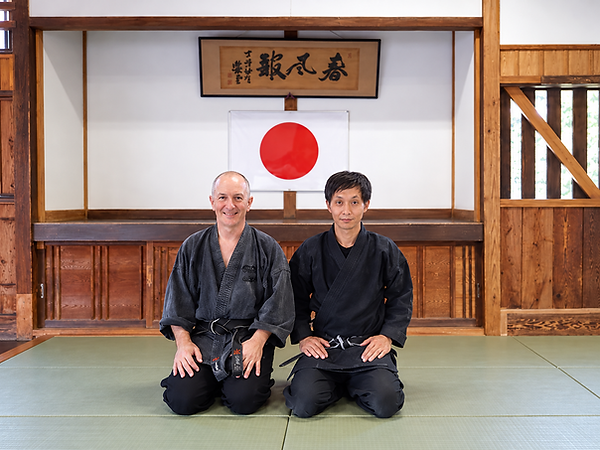
Tanaka Sensei and me. Noda, Japan. October 2019
The Way Continues
For us, there is no point at which you can say the way has ended. The body changes, understanding changes, and even the things we thought we had already learned take on a different meaning over the years.
For me, the way is to keep training, exploring and learning, to stay open to what I do not yet know, and to try to carry what I discover in training into life outside the dojo as well.
The way does not lead to a point we must reach. We simply keep walking it. The goal is the way, not the way to the goal.
The Way Begins with Training
You can read about the way and try to understand it in words, but in the end it reveals itself through the body, through the meeting with your training partner, and through the experience itself.
If this way makes you curious, you can start with a trial class.
Free of charge