

Ranks (3): Ranks in the Bujinkan - A Test Case
Updated: 8 hours ago
The series at a glance
Ranks in the Bujinkan: a test case (this chapter)
Opening
In the two previous chapters we saw two worlds. In the world of koryu, rank was a private scroll that marked trust and transmission within a lineage. In Kano's world, rank became a number and a color, visible to all and managed by an organization.
The rank system of the Bujinkan is especially interesting because it lives in both worlds at once. On the one hand it rests on classical schools with long lineages and on menkyo licenses. On the other hand it uses dan, kyu and belts, and has even taken Kano's idea of "the open ladder" (see chapter 2) further than any other organization I know.
Disclosure: I have trained in the Bujinkan since 1999 and hold the title of dai-shihan. So some of what is written in this chapter comes from personal acquaintance. Where I rely on documents I say so, and where I interpret I try to say that explicitly.
Organization, Art and Nine Lineages
The name Bujinkan means "hall of the divine warrior". It is the name of the organization founded by Masaaki Hatsumi. The art taught in it is called budo taijutsu, and Hatsumi formed it out of nine old schools (ryuha) that he headed. Three of them are considered ninjutsu and six samurai bujutsu. So the Bujinkan can be seen on three levels: the organization, the art and the nine lineages. As we will see, the rank system touches all three.

At the head of the organization stands its founder, Masaaki Hatsumi (born 1931). Hatsumi studied for fifteen years with Toshitsugu Takamatsu, head of the nine schools, who in 1968 appointed him heir to the nine schools. Takamatsu died on April 2, 1972, and by 1978 the name "Bujinkan" and the teaching title shidoshi ("teacher of the warrior's way"), which authorizes its holder to teach and open a dojo, were already in use.
What Is a Soke?
Soke literally means "the main house". The Japanese dictionary defines it as "the family at the center of a lineage or group, especially the family that has passed down the legitimate tradition in an artistic field; also the head of that family". The dictionary also notes that a synonym is iemoto, the same "house of origin" we met in chapter 1. Simply put, the soke is the head of the lineage of a particular school and the bearer of supreme authority in it.
Hatsumi is the soke of the Bujinkan as a whole, and for decades he was also the soke of each of the nine schools. In December 2019, at the annual gathering celebrating his 88th birthday, he announced his retirement from regular teaching and passed the title of soke of the nine schools to eight senior Japanese students (Sakasai Norio received two of them). Shortly afterwards, with the outbreak of the coronavirus pandemic, the Hombu Dojo, the central dojo of the Bujinkan in the city of Noda in Japan, was temporarily closed. Hatsumi remained soke of the Bujinkan as a whole, and the Hombu website continues to present him as such.
Two Layers: Lineage and Organization
Already here we can see the double structure that underlies the rank system.
The first layer is the lineages. Each of the nine schools is a lineage with its own soke. This is the world of koryu we described in chapter 1: transmission from person to person, from teacher to student. In this layer the Bujinkan also has menkyo licenses, including menkyo kaiden. For example, Toshiro Nagato, one of Hatsumi's veteran Japanese students and soke of Shinden Fudo-ryu, awarded menkyo kaiden certificates in that school to Duncan Stewart of Tasmania (2023) and to Michael Schjerling of Copenhagen (2024). Arnaud Cousergue, a dai-shihan from France, received menkyo kaiden in the sword (tachi) from Hatsumi in 2004.
The second layer is the organization. The Bujinkan as an organization awards kyu and dan ranks, issues certificates and registers them at the Hombu. This is Kano's world from chapter 2.
The layers are not entirely separate. In 1993 Hatsumi wrote in Sanmyaku, the Bujinkan newsletter of those years, that holders of 10th dan are expected to master the traditional techniques of shinden happo biken. The term is made up of "shinden" - "transmitted from the gods", "happo" - "the eight methods" and "biken" - "the secret sword". In the Bujinkan it describes the whole of the fighting skills, unarmed and with weapons, learned in the nine schools. According to him, the 10th dan rank is divided into five levels according to the five elements, chi-sui-ka-fu-ku (earth, water, fire, wind and void). "Simply put", he wrote, they correspond to shoden, chuden, okuden, menkyo and kaiden. These five levels are today's 11th to 15th dan. In other words, the upper part of the dan ladder is built on the transmission structure of koryu.
In the same article Hatsumi wrote that "the soke never has a dan". This is an interesting parallel to Kano, who according to the Kodokan also held no dan rank (see chapter 2). The one who awards the ranks stands outside the ladder.
The Ladder: From 9th Kyu to 15th Dan
The official Hombu website publishes the rank regulations and the rank application forms. The following section is based on that document.
Kyu ranks: from 9th kyu to 1st kyu. Below them is the beginner, mukyu ("without kyu").
Dan ranks: from 1st dan to 15th dan. Above them is the title dai-shihan.
Who submits the application or recommends, by rank:
9th-1st kyu: a teacher at the level of shidoshi or above.
1st-4th dan: a teacher at the level of shidoshi or above.
5th dan: after passing the sakki test, a non-technical test that I will describe later in the chapter.
Shidoshi license: optional, after 5th dan. This is the license that authorizes its holder to teach and open a dojo (see the explanation later in the chapter).
6th-9th dan: a shidoshi teacher of a higher rank than the rank requested.
10th dan: three shihan of 11th dan or above.
11th-14th dan: a teacher at the level of shihan or above, of a higher rank than the one requested.
15th dan: a teacher at the level of dai-shihan.
Dai-shihan: three dai-shihan, at least three years after 15th dan.
A few more rules from the same regulations:
The student does not apply himself. The application is submitted by his teacher.
From 4th dan upward at least one year of training since the previous rank is required, and skipping ranks is forbidden in principle.
The date of the rank is the date on which the Hombu recognized it, not the date the recommendation was given.
For each rank a rank registration fee is paid to the Hombu. There are no membership fees in the Bujinkan. We will deal with the question of money in chapter 4.
A Look Inward: No Exams
Notice what is missing from the list: there are no technical exams. Apart from the sakki test (see later in the chapter), promotion is by a teacher's recommendation. In this sense the Bujinkan is closer to koryu than to judo: the decision rests on the teacher's judgment and on the relationship between him and the student, not on a uniform exam.
Such a system has strength and also danger. The strength is that the teacher sees the student over time and not in a single moment of an exam. The danger is that when there is no outside criterion, everything depends on the teacher's integrity and judgment.
The Belt, the Wappen and the Stars
Belts in the Bujinkan are few: white for beginners, green for all kyu ranks and black for all dan ranks. By tradition, women of kyu rank wear a red belt instead of green.
Most of the information about the rank is carried by the lapel badge, worn on the left side of the chest. In Japanese it is called wappen, a word borrowed from German: Wappen means a coat of arms.
The mon tradition. The badge recalls the Japanese tradition of the mon, the family crest. According to a publication of the Japanese government, family crests were born in the Heian period (794-1185), when nobles marked their carriages with a unique emblem so that it would be clear to whom they belonged. Their original purpose was to show status, lineage and rank. In the Kamakura period (1185-1333) the samurai adopted them to tell friend from foe on the battlefield and to display the valor of the family. By the Edo period, small variations in the crest were already used to distinguish the main family from its branches, that is, to mark status within the lineage. In this sense, a badge that shows everyone who looks where you stand is a very old Japanese idea.
Lapel badges by group. There are separate badges for these groups:
9th-1st kyu: red background, white lettering and a white border.
1st-4th dan: red background, black lettering and a black border.
5th-9th dan (shidoshi): red background, black lettering, a white border around the letters and the emblem.
10th dan and above (shihan): orange background, green lettering and a blue border.
Dai-shihan: a unique badge.
The soke has a badge of his own.
The stars (hoshi). Above the lapel badge one may wear small silver or gold stars, which mark the rank within the group. The stars have existed at least since the late 1980s: in photos from that period and from the early 1990s you can already see people wearing them alongside the wappen. In practice few people use them.
Looking at the lapel badges, you can see that the Bujinkan divides its practitioners into four main groups: students of kyu rank, dan holders, teachers (shidoshi) and senior teachers (shihan), and above them the dai-shihan.
The Sakki Test
What it is. The only rank in the Bujinkan that requires a test is 5th dan. The test is called sakki, a word whose dictionary translation is "killing intent". The candidate sits in seiza (kneeling) with his back to the examiner. Many prefer to close their eyes, but this is not a rule. The examiner stands behind him with a shinai (bamboo sword) and at some point strikes toward his head. The candidate must sense the danger and evade in time.
Who examines. For many years only Hatsumi himself conducted the test, and as late as 1993 he wrote that only the soke may conduct it. According to Arnaud Cousergue, at the taikai (international training gathering) in Madrid in 2001 Hatsumi for the first time allowed others to conduct the test. Under the current regulations, the test is conducted by a dai-shihan who has received permission from the soke. As a rule it takes place at the Hombu Dojo, and with prior approval it can also be held outside Japan.
When one passes. The test is not measured by whether the strike hit or not. One passes when the examiner is convinced that the candidate felt the danger at the right moment. There are many signs of this, and an experienced examiner knows how to recognize them. In essence it is an examination of a state of mind.
What it means. Arnaud Cousergue, a dai-shihan who has watched many tests, describes it as a connection between examiner and candidate and not as an attempt to hit. According to him, one cannot "prepare" for the test with dedicated training. The ability to sense danger exists in every person, and only years of honest training uncover it again. He relates that he saw many candidates fail even though they felt the connection, because at that moment they were fascinated by what they were feeling, lost concentration and were hit. In other words, the test examines exactly what the ego interferes with: whoever comes to it out of a strong desire to "pass" or out of a need to prove something is in a state in which the chance of succeeding is small.
The sakki test is perhaps the most unique thing in the Bujinkan rank system. The only test on the whole ladder does not examine technique. It examines a state of mind. And in chapter 1 we saw that in Katori Shinto-ryu too, "mental abilities" are examined and not only physical ones.
Shidoshi, Shihan and Dai-Shihan
Shidoshi-ho ("assistant instructor"): holders of 1st to 4th dan can teach as assistant instructors under the supervision of a shidoshi. The title still appears today in the Hombu's rank application forms.
Shidoshi ("teacher of the warrior's way"): whoever has passed the sakki test and wishes to can receive a shidoshi license. The license holder may open a dojo, teach students of his own and recommend their promotion. The license is optional and is acquired separately from the 5th dan rank.
Shihan (師範): from 10th dan upward. In chapter 2 we saw that the word shihan contains the character 範, "model" or "example", as in the title hanshi.
Dai-shihan ("great shihan"): the title was first awarded in 2014. According to the regulations, it is "the highest title in the Bujinkan". It requires at least three years of training after 15th dan and the recommendation of three dai-shihan.
The dai-shihan is first of all an administrative rank. From the beginning of 2018 the title was defined as an administrative title above shidoshi. That same year Hatsumi asked the dai-shihan to work together and take care of the Bujinkan, and charged them with handling the membership cards. From my own experience as a dai-shihan too, this is a role of responsibility and administration more than "a rank above 15th dan".
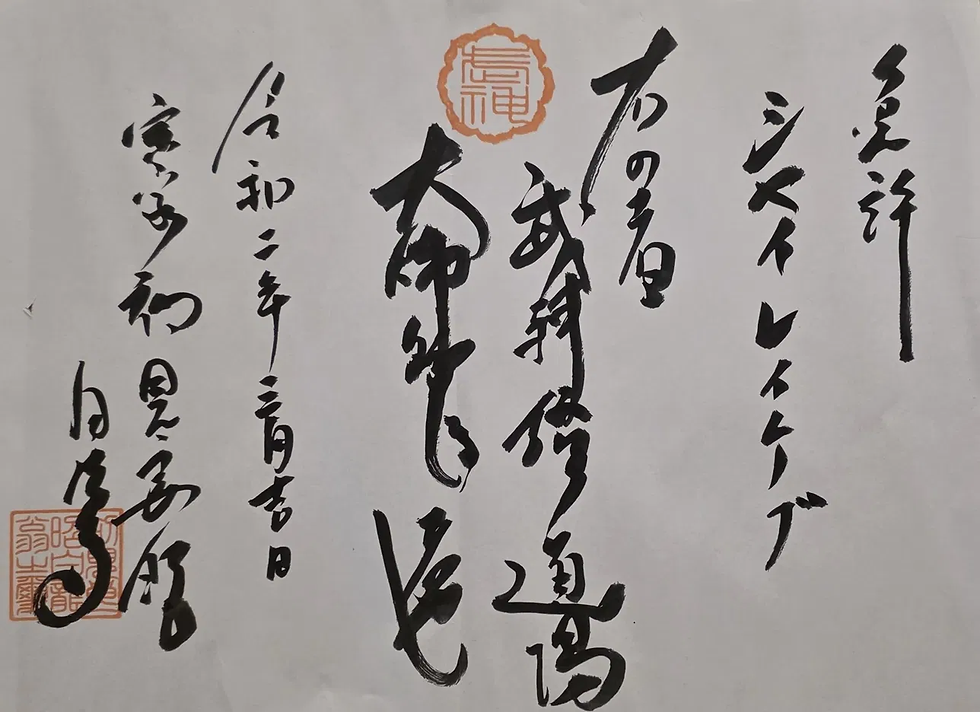
And yet, the Japanese version of the regulations has an addition that does not appear in the English version: the three recommending dai-shihan must recognize that the candidate's conduct is always an example to the other buyu ("companions on the way"). In other words, the highest title in the Bujinkan is defined not only by seniority and role, but also by character. This is exactly the logic of the hanshi title, "the model man", that we saw in chapter 2.
What Was Kept from Koryu and What Was Taken from Kano
Structure: from koryu - lineages with a soke for each school. From Kano - a numerical ladder of kyu and dan.
Who decides: from koryu - the teacher, by recommendation and not by examination. From Kano - a central organization that registers and approves.
What is examined: from koryu - character (dai-shihan) and state of mind (sakki). From Kano - seniority and fixed time intervals.
Symbols: from koryu - the menkyo ladder (shoden to kaiden) and menkyo certificates within the schools. From Kano - belts and visible lapel badges.
Ceiling: from Kano - an open ladder, which in the Bujinkan extends to 15th dan and beyond.
The Bujinkan rank system is neither "pure koryu" nor "judo with ninjas". It is an attempt to combine the two worlds: to use the motivating tools of the modern ladder while keeping within it room for the teacher's judgment, for the transmission structure of koryu, for a non-technical test and for a demand for character.
Whether this combination succeeds, and at what price, is the question of the next two chapters. Alongside the motivating tools, the longest ladder also invites the longest comparison. And when rank is set by recommendation, the responsibility for integrity passes almost entirely to the teacher.
In the next chapter: Why rank at all? Exams versus recommendations, the parallel with the education system, money and motivation, and what a rank is actually supposed to measure.
To subscribe to updates and new articles: on the contact page
Sources
Hyakusha, "Bujinkan - the organisation, not the art", 2026: article
Kotobank, the entry "宗家" (soke) (in Japanese): entry
William Boesen, Bujinkan Toryu dojo, "Bujinkan Dojo the 9 schools": page
Shidoshikai, "History of the Bujinkan": page
Bujinkan Hombu Dojo website: site
Shidoshikai, list of menkyo kaiden holders in the Bujinkan: page
Dayton Bujinkan dojo, "Mentors" (Duncan Stewart): page
Bujinkan France, "Arnaud Cousergue - Shiro Kuma": page
Masaaki Hatsumi, "Soke's Kuden", Sanmyaku vol. 1 no. 3, September 18, 1993, translated by Ben Jones: PDF
Bujinkan Hombu, rank regulations "Bujinkan Dan and Kyu Ranking System", 2025: PDF
Bujinkan Hombu, documents page: rank and shidoshi license application forms: page
Kotobank, the entry "ワッペン" (wappen) (in Japanese): entry
Government of Japan, Highlighting Japan, the history of the Japanese family crest, December 2022: article
Kotobank, the entry "家紋" (kamon) (in Japanese): entry
Arnaud Cousergue, "You Don't Know The Sakki Test!", Shiro Kuma blog, 2019: article
Arnaud Cousergue, "Sakki test 101", Shiro Kuma blog, 2014: article
Arnaud Cousergue, Shiro Kuma blog, March 2018 (on the dai-shihan and the membership cards): page


Comments